Case study
Counter-flow heat exchanger
Our latest case study explores how a counter-flow heat exchanger optimizes energy recovery in power plants. By leveraging turbine exhaust gases to pre-heat process water, the system significantly slashes operational costs. To ensure peak efficiency and equipment longevity, the design meticulously balances two critical thermal limits: preventing water evaporation within the economizer and avoiding acid corrosion by staying above the exhaust gas dew point.
Fluctuating operating conditions often force systems into inefficient cycles. Our Digital Twin solution solves this by pairing real-time sensor data with a virtual model to continuously fine-tune parameters. This ensures maximum energy recovery while strictly honoring all thermal safety constraints. Through an intuitive dashboard, operators gain total visibility into real-time performance, fouling levels for predictive maintenance, and a clear breakdown of accumulated economic gains.
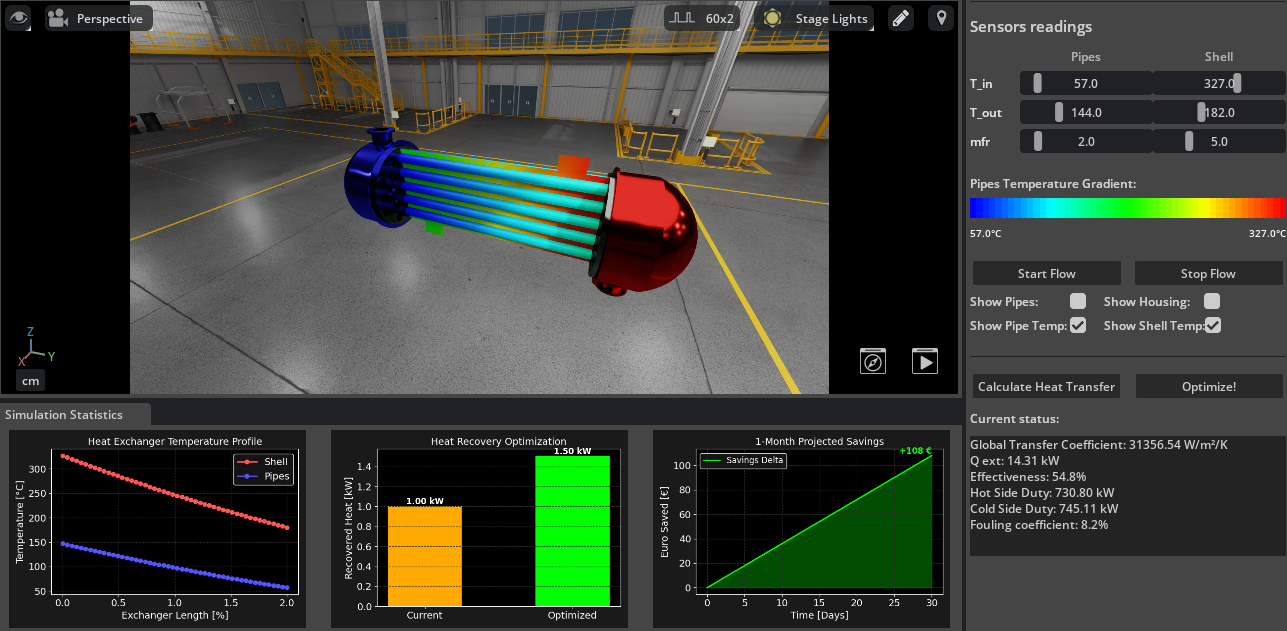
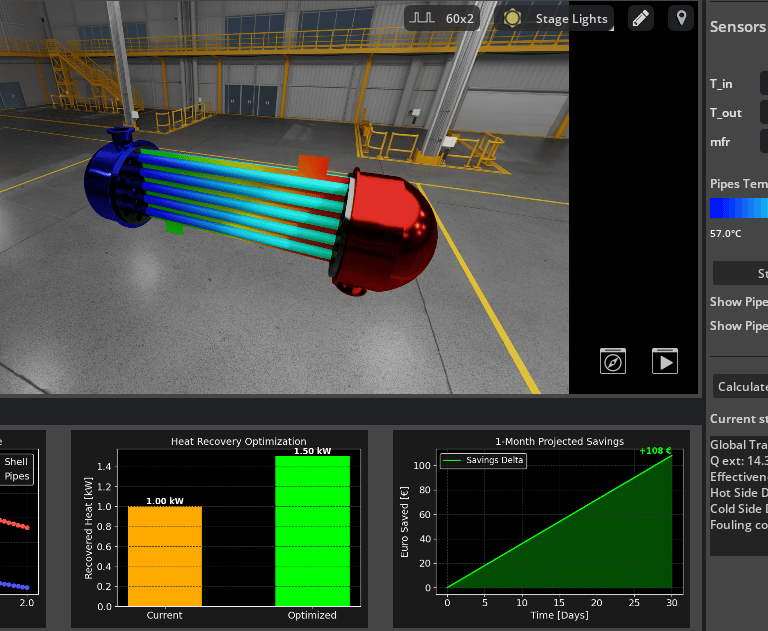
The Dashboard
Our hyper-realistic Digital Twin transforms complex data into actionable intelligence. The intuitive interface provides:
Instant Diagnostics: Rapidly assess operating health and identify anomalies through high-fidelity visualization.
Executive Overview: At-a-glance tracking of critical KPIs, including heat loss, fouling levels, and total energy recovered.
Thermal Mapping: A granular, detailed view of the internal temperature field for precise monitoring.
Optimization Benchmarking: Side-by-side comparisons of current vs. optimized working conditions to quantify performance gaps.
*In real working conditions the inlet and outlet temperatures and the mass flow rates are provided by dedicated sensors.
Optimize!
In energy production, load changes are inevitable. We tested our Digital Twin against a shift to High Power Configuration, where turbine output doubled the flue gas mass flow (from 5 kg/s to 10 kg/s) and increased temperatures from 600 K to 800 K.
The Challenge: Risk vs. Efficiency
Without intelligent management, this surge in power creates two critical risks:
Infrastructure Damage: Shell gas dropping below the sulfur dew point or pipe water exceeding boiling temperatures.
Lost Revenue: Missing the opportunity to capture the massive increase in available thermal energy.
The Solution: Real-Time Optimization
The Nexus-Labs Digital Twin continuously monitors these fluctuating conditions. With dedicated algorithms, the twin dynamically adjusts the water flow rate to its precise optimal value, ensuring the system maximizes recovery while maintaining a strict, safe "thermal window". By transitioning to an optimized state for this specific scenario, the plant achieved:
Energy Recovery: An additional 5,000 kWh per month.
Financial Gain: €100,000 in monthly savings (based on optimized operating conditions).


Contact
Reach out for precise engineering solutions.
Contact
info@nexus-labs.com
© 2025. All rights reserved.